
Summary
Executive Girmay Zahilay announced a new Executive Order to strengthen King County government by improving the accessibility of information and services.
Story
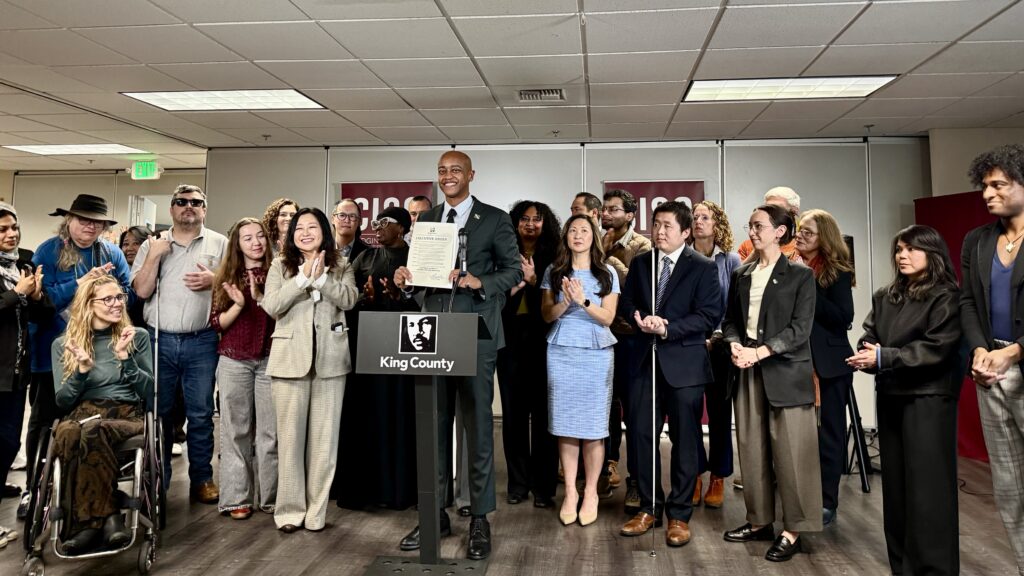
Today, Executive Girmay Zahilay signed an Executive Order to improve digital accessibility, language access, and plain language in the information and services King County provides to its residents.
The order establishes a Digital Accessibility Executive Policy to ensure King County’s digital content and services – including multimedia, electronic documents, social media, and web content – are accessible to all residents. It also directs the Executive Office to lead a Countywide assessment of language access services and plain language practices, with findings informing a future Executive Policy.
READ: Equitable Access to Information and Service Executive Order (Translations available in the County’s current Top 6 languages: Chinese (simplified), Dari, Russian, Spanish, Ukrainian, and Vietnamese)
King County is rich in linguistic, cultural, and disability diversity. Recent census data highlighted that, in 2024, for the first time, one-third of county residents aged 5 and older spoke a language other than English at home. A survey conducted by the Washington State Department of Health and the Centers for Disease Control and Prevention found that twenty percent of adults living in King County have a disability.
“We need to ensure all King County residents can meaningfully access their county government,” Executive Zahilay said. “King County is home to many cultures and languages, and residents rely on us to make decisions about their lives, businesses, and communities. This Executive Order takes concrete steps to ensure speakers of all languages and communication abilities can fully access our information and services. When residents can engage with government, programs function as intended, agencies meet their obligations, and communities are better served.”
The order will:
- Establish a Digital Accessibility Executive Policy: The Digital Accessibility Executive Policy aligns with new federal standards and ensures King County’s public-facing digital content and services are accessible to all residents. It requires all new public-facing digital content and technology countywide to be accessible starting January 1, 2027. King County departments will remediate existing content to be accessible by April 26, 2027.
- Advance language access and plain language: The Executive Office will convene a workgroup with representatives from each executive branch department to assess language access services and review existing plain language practices. Findings and recommendations are due June 30, 2027, and will inform a future Language Access Executive Policy as part of the 2028-2029 budget process.
- Strengthen oversight and accountability: The Executive Office’s Performance & Accountability Team will establish measures to monitor compliance, track progress across departments, and integrate results into regular County performance reviews.
The order was announced at the Chinese Information and Service Center, which has provided linguistically and culturally appropriate information, advocacy, social, and support services to King County residents since 1972.
What People Are Saying
Councilmember Rhonda Lewis
“Every resident deserves to understand what their county government is doing and how to get help from it. For many families in District 2 and across King County, a translated form or an accessible website decides whether they get services at all. Executive Zahilay’s order sets clear dates for county departments to make their websites and documents more accessible, and I thank the Executive for making this a priority.”
Stephen Heard, Chief Information Officer, King County Information Technology
“As more services and information are delivered online, accessibility must be built into every digital experience. This Executive Order reinforces our commitment to deliver digital experiences and services that work better for everyone.”
Dr. Susan McLaughlin, Director, Department of Community and Human Services
“Our department serves over half a million King County residents each year with critical services that support the health, well-being, safety, and happiness of our babies, kids, young people and adults. Whether it’s a parent searching our website for behavioral health support for their child, or a neighbor applying for housing assistance on their phone, finding help in those moments is only successful if the people who need them most can navigate and understand those resources. By establishing a digital accessibility policy, committing to plain language and multilingual resource standards, and strengthening our oversight, we are making a promise to our neighbors that we will meet you where you are, in a language and format that works for you, and hold ourselves accountable to making access simple, direct, and barrier-free.”
Mo McBroom, Interim Director, Department of Natural Resources and Parks
“We produce the best results when the services we provide are clear and available to the communities we serve. Executive Zahilay’s Executive Order will catalyze our efforts to make sure the work we do each day to protect and restore the natural environment is accessible to everyone who calls King County home.”
Michael Itti, Executive Director, Chinese Information Service Center
“For decades, CISC has empowered the people we serve by ensuring they can make informed decisions to achieve their goals in life. This Executive Order will help remove barriers and make it easier for our team members to serve immigrant communities across King County.”
Colin Wong, President, National Federation of the Blind Seattle Chapter
“Imagine walking to a local government office. You know that it’s open. You see people inside helping other people. You try to open the door, you knock, and you cannot get in. This is the everyday experience for people with disabilities when interacting with inaccessible websites, a place of public accommodation, in a place where people should be able to access the same information or support as anybody else. Thank you to the champions and the leaders working at King County working on digital accessibility, for eliminating barriers, increasing access, and opening doors for equal access across all King County digital content and websites.”
Carolyn Cole, Esq., Strategic Initiatives & Access Advisor, Washington State Office of Equity
“Making sure all Washingtonians can access public programs, services, information, and technology helps keep our state safe, supports businesses, and protects our rights to vote, be educated, and treated equally. This land has been home to many different languages even before the founding of our state and country and meaningful communication has always connected us to each other. With the signing of this new executive order, King County is honoring the diversity that has helped our state thrive and shows a commitment to building a government that belongs to everyone. The Washington State Office of Equity looks forward to working with King County to support these efforts.”
Maha Roy and Julie Kang, Co-Chairs, King County Immigrant and Refugee Commission
“Equitable access to government information and services is a fundamental right for every King County resident. Language barriers, inaccessible technology, and complicated communications should never prevent residents from accessing essential services or participating in civic life. We applaud Executive Girmay Zahilay, the King County Council, and grassroots nonprofits for their commitment to advancing accessibility, language access, and safety. Every King County resident deserves to be informed, heard, and treated with dignity.”
Jennifer Karls, Daisy Wong, and Allison Hastings, Co-Chairs and Secretary, King County Human and Civil Rights Commission
“Access to government information and services is fundamental to advancing human and civil rights, yet barriers continue to prevent many residents from fully participating in the systems and decisions that affect their lives. Digital accessibility, plain language, language access, and communication access are essential to ensuring that everyone can understand information, express their perspectives, and exercise their rights. For some people with disabilities, assistive technology or alternative forms of communication are equally critical. This Executive Order offers an important opportunity to strengthen dignity, belonging, and civic participation for all King County residents. Its success will hinge on whether the people most impacted by the barriers are part of the process of designing the solutions. We look forward to engaging with communities and building on these new measures.”
Kendee Yamaguchi, CEO, Asian Counseling and Referral Service
“Language access is about more than translation and interpretation. It’s about trust, dignity, and ensuring everyone can access the services they need. For more than 50 years, ACRS has worked alongside immigrants and refugees who face language and cultural barriers. We know that meaningful access begins with listening to communities and understanding their experiences. We appreciate King County’s leadership and partnership in turning community voices into meaningful action so that every resident, regardless of the language they speak, can be heard, understood, and served.”
Bilan Aiden, Vice President & Co-Founder, African Community & Housing Development; Former Co-Chair, King County Immigrant and Refugee Commission
“On behalf of African Community Housing & Development (ACHD), we commend King County Executive Girmay Zahilay and County leadership for advancing language access and accessibility across County government. As an organization serving more than 10,000 residents annually, including immigrant and refugee communities, we see firsthand how language barriers limit access to essential services, housing, economic opportunities, and civic participation. Language access is not simply about translation, it is about equity, dignity, inclusion, and ensuring every resident can fully participate in the community they call home. We are proud to have helped shape the County’s Language Access Needs Assessment through our leadership with the King County Immigrant and Refugee Commission (KCIRC). We look forward to seeing community recommendations translated into meaningful policies, accountability measures, and sustained investments that make County services more accessible to all residents, regardless of the language they speak.”
Janice Deguchi, Executive Director, Neighborhood House
“As a human services organization working primarily with immigrants, refugees and those furthest from mainstream services and opportunities, we praise the Executive for breaking down language barriers that keep so many of our neighbors from participating in their community.”
Makda Seyoum, Head of Operations, Eritrean Association in Greater Seattle
“For more than 30 years, the Eritrean Association in Greater Seattle has walked alongside immigrant and refugee families as they build new lives in King County. For many in our community, language barriers make it nearly impossible to navigate essential systems on their own, from legal and immigration processes to housing, Medicare, public benefits, etc. Our staff provide one-on-one support in Tigrinya, Amharic, Arabic, and other languages to help close that gap. Every day, we see that language access is about dignity, safety, and belonging. It’s what allows a senior to understand their healthcare, a family to secure stable housing, or a newcomer to find the help they need. We’re grateful King County listened to community voices through this assessment, and we look forward to seeing that commitment carried across every County service.”
Dorene Cornwell, WA Council of the Blind Advocacy Committee
“As more and more of everyone’s daily lives involves interfacing with digital systems, King County’s commitment to digital accessibility is a vital contribution to the fabric of our lives. KC Executive Zahilay issues an executive order that addresses digital standards, criteria in purchasing, usability, and training for employees, vendors, and all the different communities King County serves. This commitment is a valuable example of striving for Title II ADA compliance. Every other jurisdiction should embrace this example, not only because it is the law but also because standards make it easier for everyone to be on the same page technologically and to share the benefits of the digital frontier.”
Lalita Uppala, Executive Director, Indian American Community Services
“Indian American Community Services (IACS), serving more than 30,000 immigrants and refugees from India in King County, applauds Executive Girmay Zahilay’s Office and County leadership for advancing equitableaccess. When every community in King County can access and understand information and services in their language, immigrant families can participate fully in civic life, care for their well-being, and know without question that they belong. With perseverance, dignity, and pride, we will sow the seeds of belonging for generations to come.”
Heather McKimmie, Director of Advocacy and Legal Services, Disability Rights Washington
“Access to information is access to opportunity. When government communicates in clear, accessible ways, disabled people can participate fully in their communities. We’re glad King County is prioritizing the role of digital access and building accountability into their systems.”
Najma Osman, Executive Director, Somali Health Board
“At Somali Health Board, we help our community navigate systems that weren’t built with them in mind. We welcome this Executive Order as an important first step toward addressing barriers that have long prevented immigrant and refugee families from accessing essential services. Language access is a matter of health equity. This order sets an expectation that government services should be accessible to everyone, regardless of the language they speak or their ability to navigate digital systems. The work ahead is making that expectation a reality. That starts with the communities who live with these barriers every day, and with letting them decide whether access has truly improved.”
Nasir Khudaiberdiev and Marjan Didra, Co-Chairs, RISE (Refugees and Immigrants Support and Empowerment) King County Employees Resource Group
“For immigrant and refugee communities, access to information is about more than translation. It is about being heard, understood, and having the opportunity to fully participate in the community. Through our own lived experiences and our work as King County employees, we recognize how language barriers, complicated government terminology, and inaccessible digital information can prevent people from accessing services and understanding available resources. We believe every resident, regardless of language, background, or ability, deserves clear, accessible, and meaningful access to the information and services that affect their lives.”